
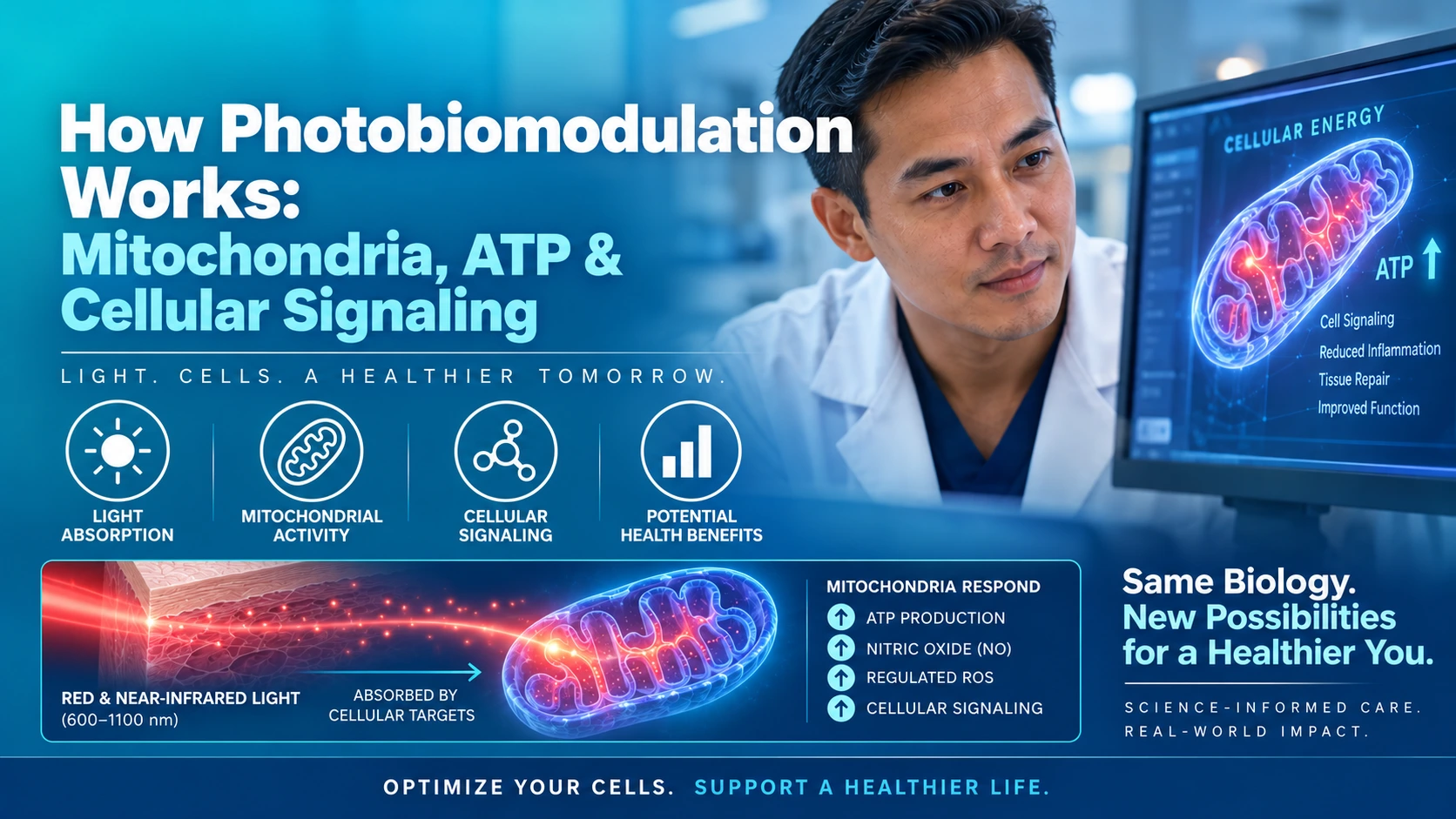
Photobiomodulation is often explained in one sentence: red light “charges” your mitochondria. The real biology is more interesting—and less certain. Light can trigger changes in energy metabolism and cell signaling, but it does not work like a battery charger and it does not guarantee a clinical result.
Step one: tissue absorbs some of the light
A PBM device sends red or near-infrared photons toward tissue. Some light reflects, some scatters and some is absorbed by molecules called chromophores. The amount absorbed depends on wavelength, skin and tissue characteristics, distance, power density and time.
Mitochondrial cytochrome c oxidase is a leading proposed photoacceptor for red and NIR light. Other pathways—including light- or heat-sensitive ion channels—may also contribute. Researchers still debate how dominant each mechanism is in different cells and wavelengths.
For more detail on how wavelength and tissue depth differ, see our red light vs. near-infrared therapy guide.
Step two: mitochondrial activity can shift
Mitochondria use an electron-transport chain to help make adenosine triphosphate, or ATP. ATP is the cell’s immediately usable energy currency. Laboratory studies suggest PBM can change mitochondrial membrane potential, oxygen consumption and ATP production under some conditions.
That does not mean cells produce unlimited energy. The response depends on the starting state of the cell and the dose. Healthy tissue, stressed tissue and damaged tissue may not respond in the same way.
Step three: small signals spread beyond ATP
PBM can also influence nitric oxide, calcium and reactive oxygen species. Reactive oxygen species sound harmful, but at low, temporary levels they can act as messages. Those messages may activate transcription factors and change how cells regulate inflammation, repair and survival.
This is called cellular signaling: a small initial event leads to a larger biological response. It helps explain why the effects, when present, can continue after the light is turned off.
Why more light can produce less benefit
PBM often shows a biphasic dose response. Too little light may not create a meaningful signal. A middle range may produce the desired response. Too much can flatten or reverse the effect.
That is why irradiance, joules per square centimeter, distance and treatment frequency matter. Our red light therapy dose guide shows the math and the practical limits.
A mechanism is not the same as evidence for a treatment
Mitochondrial and signaling research can explain how PBM might work. Clinical trials must still show whether a specific protocol improves pain, function or another outcome. A broad review of randomized trials found moderate-certainty benefits for a limited group of outcomes and low or very low certainty for many others.
Long Life Med connects the proposed mechanism to condition-specific evidence before recommending a protocol. Start with our medical red light and near-infrared therapy page.
Frequently asked questions
Does red light increase ATP?
Laboratory studies report ATP changes under some conditions. The size and direction of the response depend on wavelength, dose and cell state, so the claim should not be treated as universal.
Is cytochrome c oxidase the only target?
No. It is a leading hypothesis, but research also points to ion channels, nitric oxide and other photophysical pathways.
Are reactive oxygen species always harmful?
No. Large or sustained amounts can damage cells, while small temporary amounts can serve as signals. Dose and context matter.
How quickly does PBM work?
Some effects are immediate at a cellular level, while clinical changes—if they occur—may require repeated sessions. Timing varies by condition and protocol.
Why do studies disagree?
Different wavelengths, doses, devices, treatment sites, schedules and patient populations can produce different results. Most studies are also done on devices available to the researchers, as very few customize their own devices for their own use.
Learn what the mechanism means for your plan
If you are considering PBM in the Henderson or Las Vegas area, schedule a free first visit or call/text (702) 359-4510. We will explain the protocol in plain language and tell you where the evidence is strong, limited or still emerging.
Sources
The nuts and bolts of low-level laser (light) therapy
Mechanisms and mitochondrial redox signaling in photobiomodulation
Biphasic dose response in low-level light therapy—an update