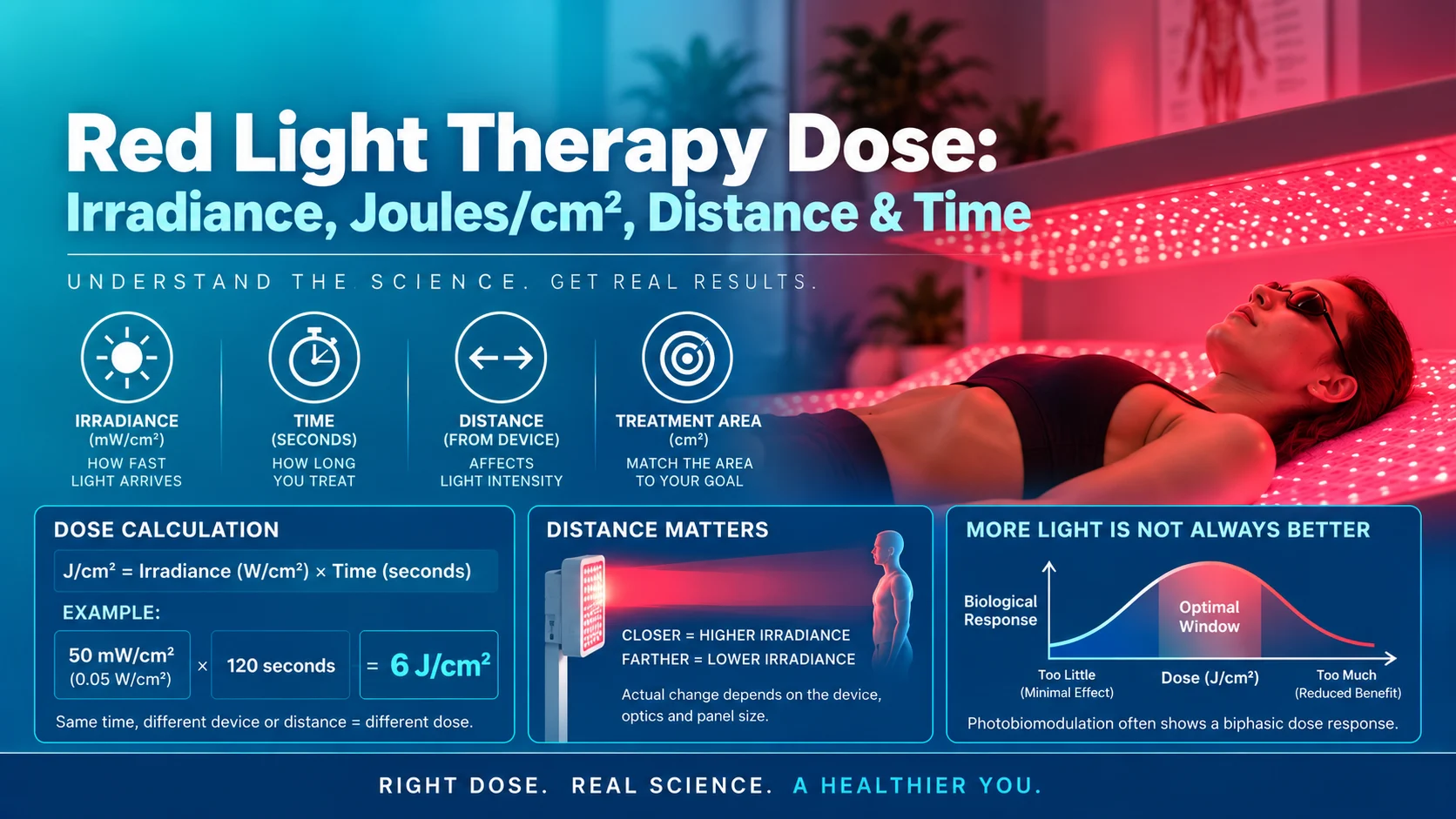
“Use it for ten minutes” is not a complete red light therapy dose. Ten minutes near a high-output panel can deliver far more energy than ten minutes several feet away from a weaker device. To compare protocols, you need four pieces: irradiance, time, distance and treatment area.
Irradiance: how fast light arrives
Irradiance is the power of light reaching a surface, commonly reported as milliwatts per square centimeter (mW/cm²). It is a rate—like water flowing from a faucet—not the total amount delivered.
Use the measured irradiance at the distance and setting you will actually use. Manufacturer “maximum” numbers measured at the LEDs may not match what reaches your skin.
Joules per square centimeter: the energy dose
Energy density, often called fluence, is reported in J/cm². The basic calculation is: irradiance in W/cm² × time in seconds = J/cm².
Example: 50 mW/cm² equals 0.05 W/cm². At that irradiance, 120 seconds delivers 6 J/cm². This calculation is useful, but it does not prove that 6 J/cm² is the correct clinical dose for a particular condition.
Distance changes more than convenience
Moving away from a panel usually lowers irradiance and may change how evenly the light covers the body. The exact change depends on LED optics, panel size and beam overlap, so a simple inverse-square calculation may not accurately describe a near-field panel.
If the device provides irradiance measurements at several distances, use the closest match. Otherwise, ask how the value was measured.
Time and frequency are separate variables
Longer exposure raises total energy when irradiance stays the same. Treatment frequency changes cumulative exposure and the time tissue has to respond between sessions. A protocol should state both session time and schedule.
Why more is not always better
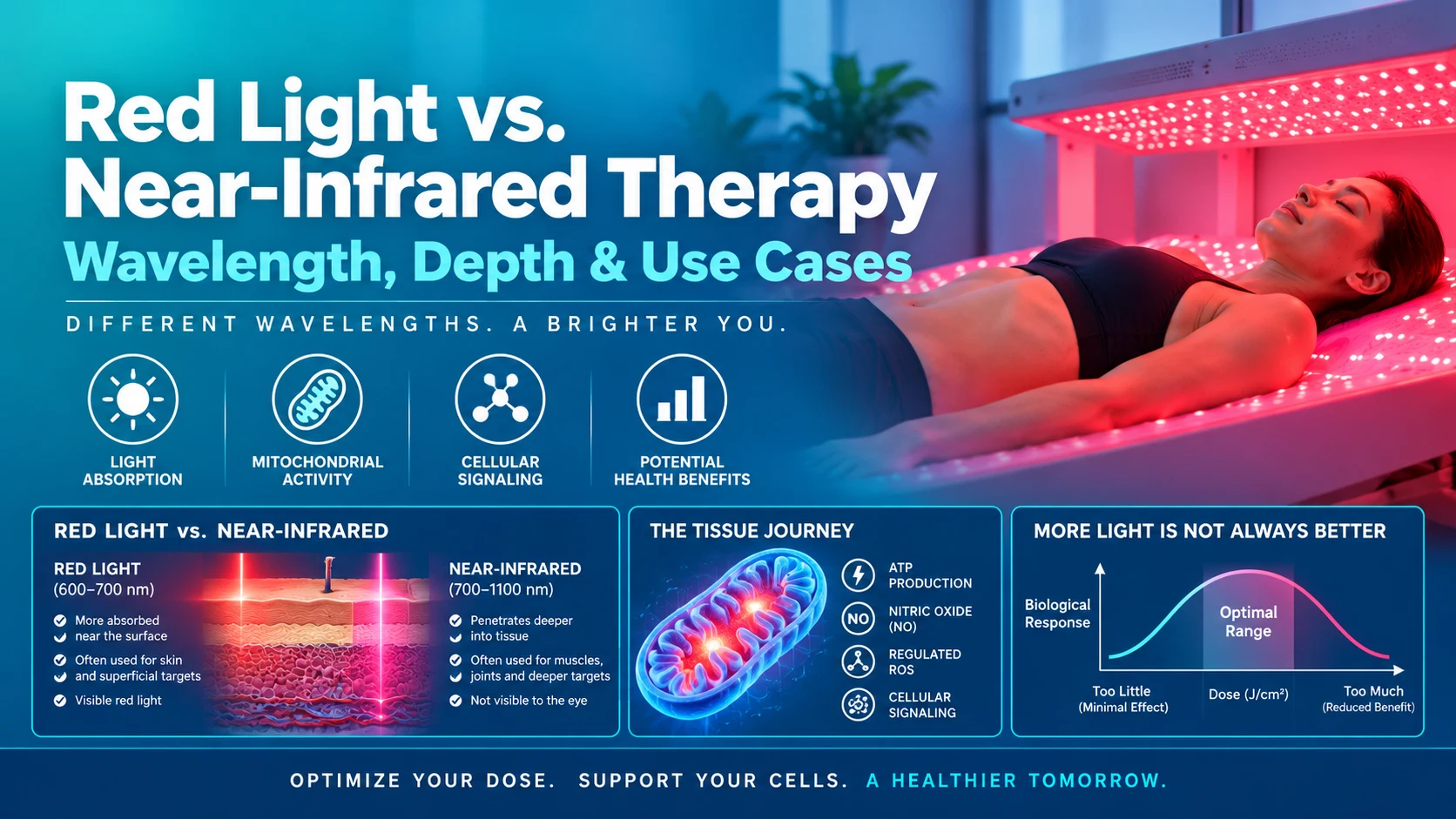
PBM research describes a biphasic response: a dose can be too low, fall within a useful window or be high enough to reduce the desired effect. ATP, mitochondrial membrane potential and signaling molecules can all show dose-dependent patterns.
Learn more about how photobiomodulation works, including the role of mitochondria, ATP, and cellular signaling.
This is why adding minutes after a disappointing session is not automatically the right move. The wavelength, placement, distance and frequency may need adjustment instead.
How Long Life Med individualizes treatment
Your provider matches the device and settings to the body area and care goal, then tracks symptoms and function. Our current full-body options include an open treatment bed and two therapy cocoons with different wavelength mixes. See the sessions, packages and equipment guide and the medical PBM service page.
Frequently asked questions
What is a good red light therapy dose?
There is no universal dose. Useful ranges differ by condition, wavelength, device, treatment site and study protocol.
Can I calculate dose from device wattage?
Not reliably. Electrical wattage and LED rating are not the same as optical irradiance reaching your skin.
Does doubling time double the dose?
If irradiance and all other conditions stay constant, doubling time doubles J/cm². Tissue response may not double.
Why does distance matter?
Distance changes irradiance, beam overlap and coverage. Use measurements taken at the actual treatment distance whenever possible.
Should I use PBM every day?
Only if the condition-specific protocol and your response support it. Frequency is part of the dose.
Get a dose you can explain
If you want a provider to connect wavelength, irradiance, time and distance to a specific goal, schedule a free first visit in Las Vegas or Henderson. Call/text Long Life Med at (702) 359-4510.
Sources
Biphasic dose response in low-level light therapy—an update
Review of light parameters and photobiomodulation efficacy