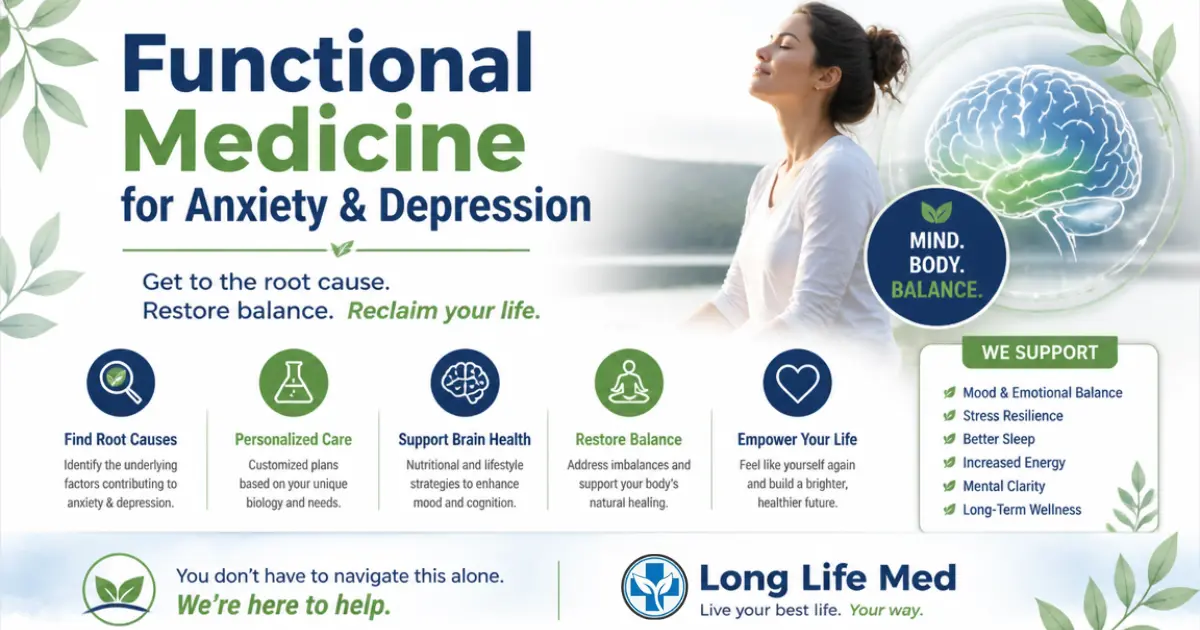
Most people who’ve dealt with anxiety or depression long enough have had some version of this experience: you describe your symptoms, you get a prescription, and maybe a referral for therapy. If the first medication doesn’t work, you try another. Then another. Dosages get adjusted. Side effects pile up. And through all of it, nobody asks the question that seems obvious: what’s actually causing this?
That’s not a knock on psychiatry or conventional mental health care. SSRIs and SNRIs help a lot of people. Therapy helps a lot of people. But for a significant number of patients, the standard playbook treats the symptom without ever investigating the mechanism behind it. And that’s where functional medicine offers something meaningfully different.
Learn more about functional medicine in Las Vegas and Long Life Med’s approach to root-cause care.
Anxiety and Depression Aren’t Always a Brain Chemistry Problem
The “chemical imbalance” theory of depression has been the dominant narrative for decades. Low serotonin equals depression. Boost serotonin, fix the problem. It’s a clean story, but the science has moved well past that simplification.
Research now points to multiple overlapping systems that can drive or worsen anxiety and depression: chronic inflammation, gut microbiome disruption, hormonal imbalances, blood sugar instability, nutrient deficiencies, thyroid dysfunction, and even environmental toxin exposure. For many patients, what presents as a psychiatric condition has metabolic, endocrine, or gastrointestinal roots.
That doesn’t mean the suffering is less real. It means the solution might look different than a prescription pad.
What a Functional Medicine Workup for Anxiety or Depression Actually Looks Like
A functional medicine provider approaches anxiety and depression the same way they’d approach any complex, multi-system condition: by investigating.
See how functional medicine works at Long Life Med for a broader look at the evaluation and care process.
Hormonal evaluation. Thyroid function is a big one. Not just a basic TSH screen, which often misses subclinical dysfunction more than most patients realize, but a comprehensive thyroid panel including free T3, free T4, reverse T3, and thyroid antibodies. Cortisol patterns matter too. Chronic stress doesn’t just feel bad. It disrupts the HPA axis and changes how your brain processes mood, sleep, and stress response. For men, low testosterone is frequently linked to depressive symptoms. For women, perimenopause and menopause-related hormonal shifts are a well-documented trigger for both anxiety and mood changes.
Gut health assessment. Roughly 90% of your body’s serotonin is produced in the gut, not the brain. Gut dysbiosis, intestinal permeability, chronic low-grade infections, and food sensitivities can all affect neurotransmitter production and inflammatory signaling. A patient with persistent anxiety who also deals with bloating, irregular digestion, or food intolerances may find that their mood issues and their gut issues share the same root.
Inflammatory markers. Chronic, low-grade inflammation has been linked to treatment-resistant depression in particular. Testing markers such as hs-CRP, homocysteine, and certain cytokines can help determine whether systemic inflammation is contributing to mood symptoms that haven’t responded to conventional treatment.
Nutrient status. Deficiencies in vitamin D, B12, folate, magnesium, iron, and omega-3 fatty acids are all associated with increased anxiety and depressive symptoms. These are testable, correctable factors that rarely get checked in a standard 10-minute visit.
Blood sugar and metabolic health. Insulin resistance and blood sugar swings don’t just affect your waistline. They affect your brain. Patients with metabolic dysfunction frequently report mood instability, irritability, brain fog, and anxiety, symptoms that resolve or improve significantly once metabolic health is addressed.
Why This Matters for People Who’ve “Tried Everything”
Functional medicine doesn’t replace psychiatric care. If someone is in crisis or medication is keeping them stable, that’s not the time to overhaul their treatment plan on a whim.
But for patients who’ve been on medications for years without resolution, who’ve tried multiple prescriptions with diminishing returns, or who suspect there’s something else going on beneath the surface, a functional workup can uncover treatable drivers that were never identified. Correcting a thyroid issue, resolving a gut infection, optimizing vitamin D and magnesium levels, or addressing cortisol dysregulation can produce meaningful, measurable shifts in mood and anxiety levels.
The point isn’t to pick a side between conventional and functional. The point is to be thorough.
How Long Life Med Treats the Whole Picture
At Long Life Med in Las Vegas, NV, the approach to anxiety and depression starts where it should: with a full investigation. NP David doesn’t do 15-minute visits. Initial consultations run 1 to 3 hours because complex conditions require time, not shortcuts.
That first visit includes a comprehensive health intake covering medical history, lifestyle, diet, stress, environment, medications, and supplements. A full physical assessment establishes your baseline, including body composition. Advanced testing is ordered based on your case: hormone panels, inflammatory markers, gut health evaluation, nutrient levels, and metabolic markers. From there, a personalized care plan is built around what the data actually shows, not a one-size-fits-all protocol.
The clinic’s patient panel is capped at 300. That’s roughly 5% of what a typical primary care practice manages. The result is same-day or next-day availability, extended visits, and a provider who knows your history without having to re-read your chart.
Standalone functional medicine visits start at $250 for the initial consult (plus $150 to $500 in labs depending on your case), with follow-ups at $150. For patients who want ongoing care, the Preferred DPC membership at $200/month ($2,000/year) includes functional medicine coaching, semi-annual labs with advanced cardiac panels, semi-annual physicals, unlimited urgent care and primary care visits, a personalized health optimization plan, and 24/7 text access with guaranteed response hours from 7 am to 9 pm. Annual prepay unlocks a $400 lab credit, $100 supplement credit, and up to 20% off additional services.
All DPC memberships are HSA and FSA-eligible. No insurance required. No co-pays. No deductibles. Superbills are provided for those who want to pursue reimbursement.
When Symptoms Have a Deeper Source
Anxiety and depression are real, debilitating conditions. They deserve more than a quick label and a prescription. If you’ve been managing symptoms without improvement, or if you’ve always wondered whether something else might be contributing, a functional medicine evaluation can give you answers that a standard visit simply doesn’t have time to look for.
Schedule a free first visit or call (702) 359-4510.