The confusion between these two models is understandable. Both are membership-based. Both promise better access to your provider. Both involve paying out of pocket. But the similarities mostly stop there, and choosing the wrong one means either paying significantly more than you needed to, or signing up for something that doesn’t deliver what the marketing implied.
This is worth understanding clearly before you commit.
What Concierge Medicine Actually Is
Concierge medicine, sometimes called retainer medicine, involves paying a physician a membership fee in exchange for enhanced access. Appointments are longer. Waits are shorter. The doctor’s direct number is available.
The catch is that most concierge physicians still bill your insurance on top of the retainer. You’re paying the membership fee for access and convenience, but the actual medical care is still running through the insurance system. That means you still need coverage. You still face co-pays in many cases. And the doctor’s patient panel, while smaller than a typical PCP, can still run into the thousands.
Annual concierge fees in Las Vegas typically range from $1,500 to $10,000 or more depending on the practice and the access level promised. What you actually get for that number varies enormously.
What Direct Primary Care Is
Direct Primary Care (DPC) removes the insurance middleman from primary care entirely. There’s a flat monthly membership fee. In exchange, you get unlimited primary care visits, same-day or next-day appointments, and wholesale pricing on labs and medications. No co-pays. No deductibles. No billing department.
Learn more about how direct primary care works at Long Life Med.
At Long Life Med, the DPC membership starts at $200 per month. That covers unlimited primary care, urgent care for members, and extended visits ranging from 30 to 90 minutes with NP David, who caps his patient roster at 300. Not 3,000. Not 6,000. Three hundred.
Because there’s no insurance billing, there’s no financial incentive to rush visits or stack as many appointments as possible into a day. The revenue model is built around keeping patients healthy over time. That changes what an appointment actually feels like.
The Insurance Question
This is the most practically important difference between the two models.
Concierge medicine, in most cases, still requires you to maintain health insurance. You’re paying for two things simultaneously: the retainer and the premiums. For some patients that’s a reasonable trade-off. For many, it isn’t.
DPC doesn’t bill insurance and doesn’t require it for primary care. The membership fee is transparent, and for covered services, that’s the only cost. Memberships are HSA/FSA eligible, which means you can pay with pre-tax dollars and reduce the effective cost further.
If you have insurance, most patients keep a high-deductible or catastrophic plan for specialist referrals and hospital-level events. But for everything that normally flows through a primary care physician, the DPC membership replaces that, typically at a fraction of what insurance co-pays and deductibles were costing.
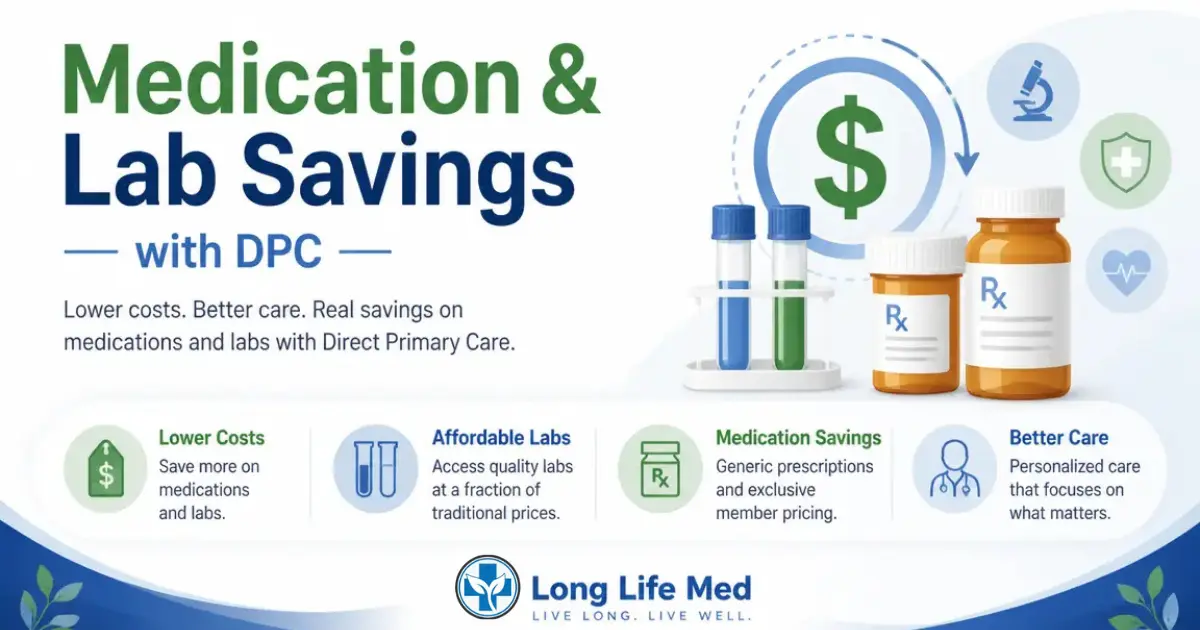
Lab pricing makes this concrete. A comprehensive metabolic panel billed to insurance, after negotiation and deductible math, can run $80 to $150 out of pocket. At Long Life Med, the same panel runs $15 to $30 at wholesale pricing. That gap adds up quickly for patients who need regular monitoring.
How Long Life Med Fits Into This
Long Life Med is a DPC clinic. If you’re comparing practices, here’s how to find a direct primary care provider in Las Vegas. We’ve built our model around meaningful access for patients who want real care at a sustainable cost, not a premium tier of the same insurance-based system with a shinier waiting room.
We also layer functional medicine and longevity services on top of the DPC foundation. Most DPC clinics stop at primary care. We go further because our patients want more than a provider who handles acute complaints. They want a medical partner who understands their labs, their hormones, their metabolic health, and where they’re headed over the next decade.
The Preferred membership at $200 per month provides a $400 annual lab allowance toward suggested semi-annual labs, a $100 annual supplement allowance, unlimited primary care, and urgent care for members. The Executive membership at $500 per month goes further, with a $1,500 annual lab allowance toward suggested quarterly labs including genetic testing, suggested quarterly physicals, 24/7 urgent care access, and up to 30% off services and products.
Who Each Model Actually Serves
Concierge medicine tends to serve patients who want premium access to a traditional insurance-based physician and are willing to pay extra for it. If your existing coverage is strong and you mainly want shorter waits and a cell phone number for your doctor, it can be a reasonable fit.
DPC makes more sense for patients who are frustrated with the insurance system entirely. Who want wholesale pricing on care and labs. Who want a provider with a dramatically smaller panel and extended face-to-face time. Who want to pair their primary care with functional medicine and longevity services rather than cycling through specialist referrals that never quite add up to an answer.
If you’re comparing options in the Las Vegas and Henderson area, most patients who’ve spent years on the insurance treadmill don’t want a fancier version of the same system. They want out of the system. That’s what DPC is designed to provide.
Frequently Asked Questions
Is Direct Primary Care the same as concierge medicine?
No. Both use a membership model, but concierge practices typically still bill insurance on top of the retainer fee. DPC removes insurance from primary care entirely. The cost structure, patient panel size, and philosophy are meaningfully different.
Can I use my HSA or FSA for a DPC membership?
Yes. DPC memberships are HSA/FSA eligible, which means you can pay with pre-tax dollars. This reduces the effective cost and makes the membership accessible to a wider range of budgets.
Does DPC replace health insurance completely?
DPC replaces what insurance was doing for primary care. Most patients keep a high-deductible plan or catastrophic coverage for specialist referrals, imaging, or hospital-level events. DPC handles the care that would otherwise flow through a primary care physician.
How is Long Life Med different from other DPC clinics in the Las Vegas area?
Long Life Med combines Direct Primary Care with functional medicine and longevity services. Most DPC practices stop at primary care. We also offer hormone optimization, medical weight loss, IV therapy, red light therapy, regenerative medicine, and root-cause diagnostics, all under one roof with one provider who actually knows your case.
What does a DPC membership cost at Long Life Med?
The Preferred membership is $200 per month ($2,000 per year). The Executive membership is $500 per month ($5,000 per year). Non-member functional medicine consultations are $250 for initial visits and $150 for follow-ups.
Ready to get started?
If that’s what you’re looking for in the Henderson or Las Vegas area, schedule a free first visit or call/text
(702) 359-4510 | hello@longlifemed.com
8870 S Maryland Pkwy, Ste 115, Las Vegas, NV 89123 | Mon-Sat 8AM-8PM