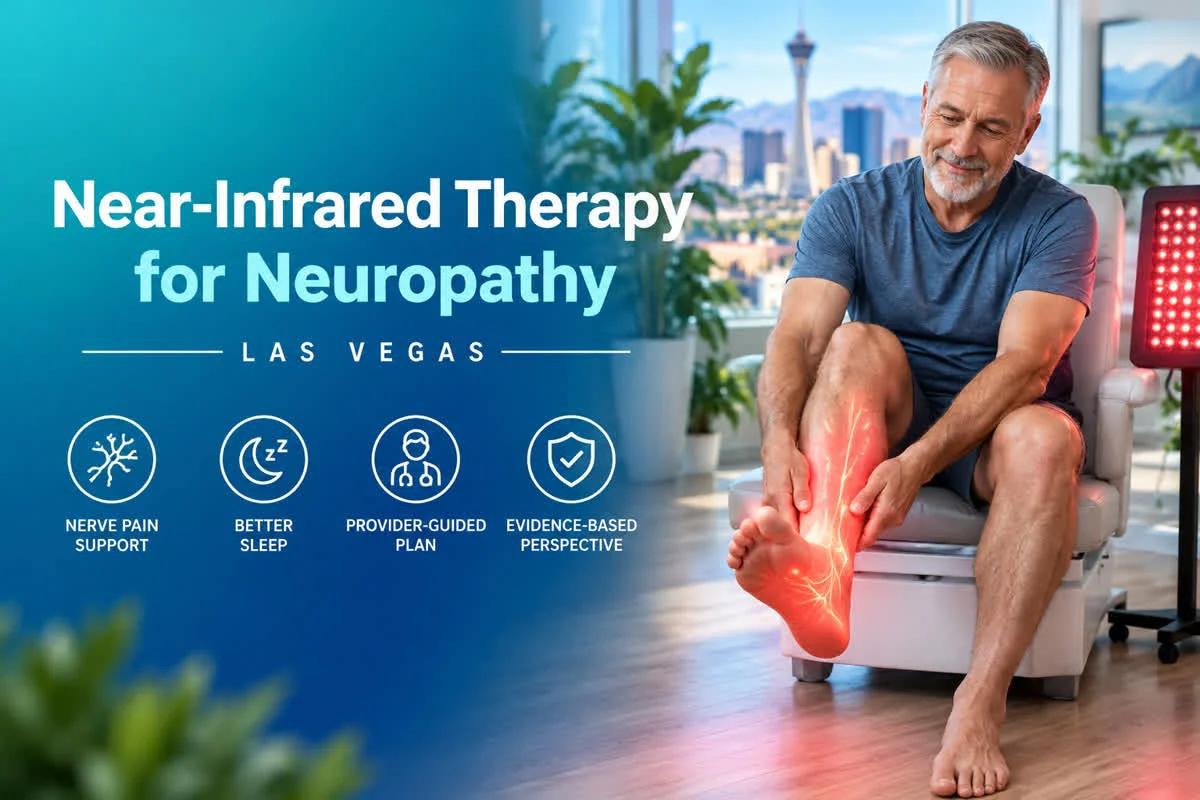
Burning feet, tingling, or pain from the touch of a bedsheet can make it difficult to rest. Numbness brings a different concern: you may not notice an injury as quickly. When neuropathy affects your day, a treatment described as noninvasive and drug-free can sound appealing.
Near-infrared light therapy has been studied for neuropathic symptoms, particularly painful diabetic peripheral neuropathy. Some human studies suggest pain benefits; others do not. The useful question is whether a specific treatment could support your care—not whether light can be counted on to reverse nerve damage.
Start by understanding the nerve problem
Neuropathy describes a problem affecting nerves; it does not identify a single cause. Diabetes is an important cause of peripheral neuropathy, but an assessment may also consider issues such as vitamin B12 deficiency, thyroid problems, or kidney disease. The pattern of symptoms and your medical history help guide the evaluation.
At Long Life Med, a conversation with NP David starts with what you feel, where you feel it, and how it affects daily life. Bring a medication and supplement list, previous results, and information about when symptoms began. Tests should answer clinical questions rather than substitute for a careful history.
What the NIR research supports—and where it falls short
Near-infrared is invisible light used in some photobiomodulation, or PBM, treatments. Visible red light is also used in PBM. Studies vary in wavelength, dose, treatment area, and whether light is combined with another therapy, so the word “infrared” alone does not tell you how a treatment was delivered.
The evidence is mixed. A 2017 review of randomized trials found low-quality evidence and no reliable sustained improvement in foot sensitivity or neuropathic pain with monochromatic infrared treatment. That is an important counterweight to broad online claims about restoring sensation.
A later randomized trial published in 2025 reported lower pain and better sleep with an 890-nm infrared protocol added to physical therapy for painful diabetic polyneuropathy. The finding is encouraging for that population and protocol, but it is not proof that all whole-body NIR sessions produce the same effect.
Pain relief, restored protective sensation, and nerve regeneration are different outcomes. Feeling less pain does not prove that a damaged nerve has healed. Animal experiments and laboratory findings also cannot establish that a treatment reverses neuropathy in people. We would not promise a cure or generalize results from diabetic neuropathy to every cause of nerve pain.
Why reduced sensation changes the safety conversation
When sensation is reduced, comfort alone is not a reliable guide to skin exposure or temperature. Your provider needs to know about numb areas, wounds, circulation concerns, light sensitivity, and relevant medications before choosing a treatment.
Follow the device’s positioning, skin-check, and eye-protection instructions. Do not increase the intensity or duration because you cannot feel much during a session. If a device also produces heat, that feature needs particular attention when you have difficulty sensing temperature.
Check your feet daily if you have diabetic neuropathy. Report sores, swelling, or other changes promptly rather than waiting for the next scheduled light session. A wound or changing foot needs assessment of its own; a pain-treatment appointment should not delay that care.
What a provider-guided trial should look like
Our medical red light and near-infrared therapy service uses customized whole-body PBM devices. Their exposure is not interchangeable with the targeted pads or lasers used in a particular study. NP David can explain the available device, the treatment goal, and the limits of applying research to your situation.
If PBM is appropriate, set goals you can track, such as nighttime pain, sleep interruption, or comfortable activity. Agree on a review point before committing to an open-ended series. Track adverse effects as well as improvement, and keep the rest of your care plan in place.
Our functional medicine care considers lifestyle, nutrition, medications, supplements, and relevant testing. With a roster capped at 300 patients, we make room to discuss those details with one primary provider. The aim is a coordinated plan for the person experiencing the symptoms, rather than a light-therapy package selected from a diagnosis label.
Questions about NIR therapy for neuropathy
Can NIR therapy regenerate damaged nerves?
Human evidence does not establish that the whole-body treatment offered here regenerates damaged nerves. Possible pain relief should not be described as proof of nerve repair or restored protective sensation.
Does the research apply to every kind of neuropathy?
No. Evidence from painful diabetic peripheral neuropathy cannot automatically be applied to chemotherapy-related neuropathy, nerve compression, or other causes. Discuss your diagnosis and the relevant evidence with your provider.
Can I stop medication if I try light therapy?
Do not stop or reduce prescribed medication on your own. Changes should be discussed with the clinician managing your neuropathy and underlying condition.
Is treatment safe if my feet are numb?
Numbness requires extra attention to skin condition and exposure. It is a reason for a provider assessment and device-specific precautions, not a reason to increase the treatment time until you feel something.
Discuss neuropathy care with NP David
If that is what you are looking for in the Henderson or Las Vegas area, schedule a free first visit or call/text (702) 359-4510 to see if Long Life Med is the right fit. We can discuss your symptoms, current care, and whether a trial of NIR therapy is reasonable.
Visit us at 8870 S Maryland Pkwy, Ste 115, Las Vegas, NV 89123, serving Silverado Ranch and surrounding Southern Nevada. You can also reach us at hello@longlifemed.com.